
Blog posts tagged "Juju"
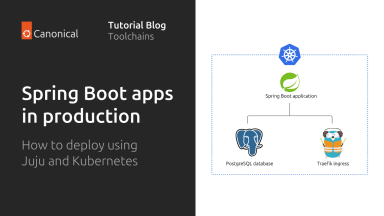
In this article we walk through the steps required to deploy a Spring Boot application to production using Juju and Kubernetes. The goal is to showcase the integration of the application with essential services like PostgreSQL for database management and Traefik for ingress control.

Data centers don’t have to be power-hungry monsters. With smart automation using tools like MAAS, you can reduce energy waste and operational costs, and make your infrastructure greener, without sacrificing performance or flexibility.

One of my favourite authors, Douglas Adams, once said that “we are stuck with technology when what we really want is just stuff that works.” Whilst Adams is right about a lot of things, he got this one wrong – at least when it comes to infrastructure. As our Infra Masters 2025 event demonstrated, infrastructure

Observability is critical for web operations to ensure that the application is working as expected and to identify any potential issues. However, setting up observability has traditionally been challenging because it can take hours to set up all the infrastructure, instrument your code and enable observability in production. But now there

Learn how Canonical is using Python Flask and the 12-factor charm framework to simplify the development of Canonical.com and Ubuntu.com

Canonical is excited to announce that we are collaborating with OpenAirInterface (OAI) to drive the development and promotion of open source software for open radio access networks (Open RAN). Canonical will bring automation in software lifecycle management to OAI’s RAN stack, alongside additional infrastructure capabilities. This will be

For a native integration for Canonical’s Kubernetes platform, Juju was the perfect fit, and the charm makes consuming CloudCasa seamless for users.
Kubernetes is the open source, industry-standard platform for deploying, managing and scaling containerized applications – and applications on Kubernetes are easier with operators.
Operate popular open source on Kubernetes – Attend Operator Day at KubeCon EU 2024
In today’s blog we take a closer look at roles – the key elements that make up the design pattern – and how they work together to simplify maintaining application infrastructure.

If you missed Operator Day, we have good news: starting January 4th, we will present weekly on-demand events week covering the presentations step by step.

The 7th Operator Day is a virtual event and will take place on the first day of the KubeCon week, Monday, 6 November 2023. The event is entirely virtual. You can dial in from anywhere and attend. You can register at the KubeCon NA 2023 conference or directly at the event page.

How enterprise DevOps teams can automate repetitive tasks while staying in control Low-ops means minimising the effort for operating applications by automating as many tasks as possible. However, given the maximum automation, how can an SRE or DevOps engineer stay in control? Doesn’t automating tasks and being in control sound like a par

OpenStack is no doubt a wonderful and successful piece of software. It allows you to create your own cloud infrastructure, and thanks to its open-source nature, it’s free to use for everyone. But as with many giant software projects, all that power comes with a challenge: it is reasonably complex to install and configure. A

The Operator Day at KubeCon EU 2023, hosted by Canonical, took place on Monday, 17 April 2023. We thank everyone for attending the event. Our thanks go out especially to those who engaged with each other during the sessions, asked questions and contributed to our interactive event. If you missed this 6th edition of Operator

With Juju, Indico can be easily deployed on private clouds as well as on a public cloud. Juju and Charmed Operators provide for all the elements of Indico, such as the Web server, storage, and databases, a uniform interface for operations and an abstraction from the deployment infrastructure – reducing efforts significantly.